
How we work
Our methods make change stick.
Integrated organization design expands what’s possible.
We solve complex problems by designing organizations as integrated, living systems.
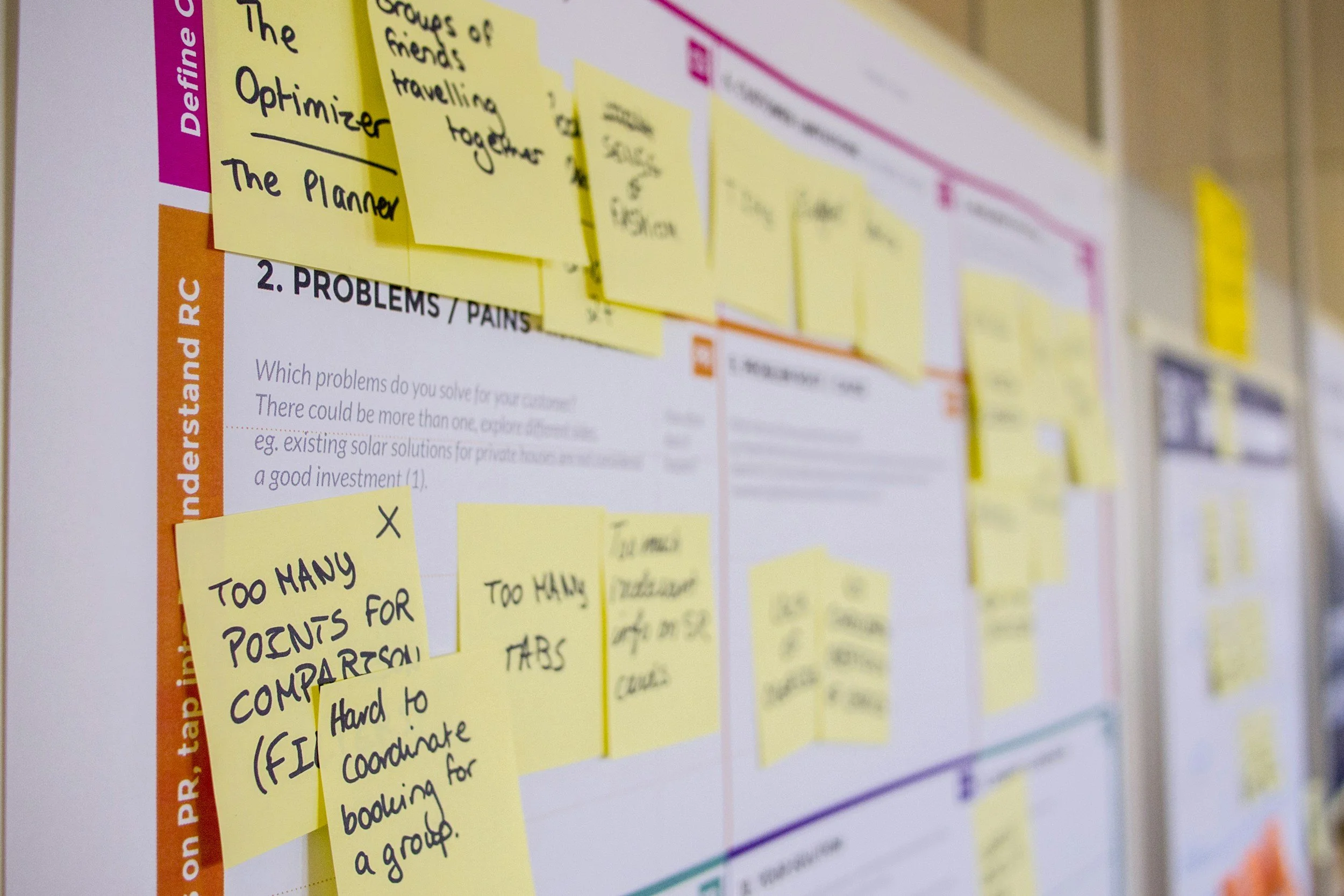
Using a human-centered service design methodology, we focus on the interconnectedness of stakeholders and systems. We map what stakeholders* actually experience. Then, we work backward to design the strategy, systems, processes, and structures that deliver those experiences reliably and at scale. We explore all elements of your organization, then redesign your organization to operate in a state of flow.
Research enables us to identify the root causes of current challenges and identify patterns that might lead to future problems. Using a variety of tools and practices, we collaborate with you and your stakeholders to co-create solutions. Then, we prototype and test to de-risk any plan of action before implementing a full-scale solution.
*Stakeholders will vary depending on the organization, but often includes: customers or beneficiaries, leadership, employees, contractors, board members, investors or donors, strategic partners, and others.
Progress through each phase, starting with research
CONDUCT RESEARCH. PRODUCE INSIGHTS.
01 | Separate signal from noise
What we do:
Identify current challenges in your organization and patterns that might lead to future problems using a combination of methods (e.g., stakeholder interviews, observations, workshops, metrics, and/or secondary research)
Make the invisible visible—translate your big picture into usable frameworks, not lengthy documents.
What you get:
Key insights identifying systemic issues and opportunities, not just symptoms
A usable framework for understanding your organization
Early stakeholder buy-in
Working session with your leadership team
FORMULATE PROBLEM. DISCUSS PATHS FORWARD.
02 | Define the overarching challenge
What we do:
Formulate the overarching problem with an integrated organizational design lens (see case studies for examples)
Identify misalignment, and untangle complexity to find the right starting point—the intervention that will create the most leverage
What you get:
Collaborative working session
A clear starting point to transform your organization, with greater confidence in the direction because it is rooted in data
Greater stakeholder buy-in
Leadership and team capacity-building
Documentation of decisions with rationale
GENERATE IDEAS. CONVERGE ON PROMISING OPTIONS.
03 | Co-create possible solutions
What we do:
Explore a wide range of possible solutions to the problem
Converge on the ideas and solutions that will give your organization the most leverage
What you get:
Collaborative working session
A wide range of ideas to solve the defined problem
1-3 solutions selected to advance to the prototyping phase
Stakeholder alignment
Leadership and team capacity-building
DEVELOP PROTOTYPES. TEST AND LEARN.
04 | De-risk by testing prototypes
What we do:
Build small-scale versions of 1-3 solutions
Test with real stakeholders (staff, customers, beneficiaries, funders, etc.)
Gather feedback, iterate, and refine before full implementation
What you’ll get:
Collaborative working session
Prototypes for testing
Data that enables you to decide which solution(s) to pursue
Clarity about resource allocation in your organization
Greater stakeholder alignment
Additional leadership and team capacity-building
IMPLEMENT ADAPTIVE SYSTEMS. UPSKILL YOUR TEAM.
05 | Scale what works
What we do:
Embed solutions—strategy, systems, processes, capabilities—into your organization that solve the problems of today while being flexible enough to adapt as you scale.
Work with your team until the changes stick and they have what they need to maintain this practice going forward. This might include team involvement throughout the engagement, coaching, professional development, and/or training.
Provide your organization with additional capacity during the transition (if needed) so your team isn’t overwhelmed maintaining or closing out old ways of working while implementing new approaches to the work.
What you get:
Collaborative working session
Coaching for leadership and your team
Frameworks and systems for implementation and ongoing adaptation
Fractional or temporary team members during transition phase (if needed)
Frequently asked questions
-
Every engagement begins with research, no exceptions. Research is the foundation for everything that follows. After the research phase, we will progress to the next phase. While you cannot skip phases, we can collaboratively scope the engagement one phase at a time instead of all at once.
Every engagement is custom based on research insights, the overarching problem we decide to solve, the number and type of prototypes, and what we mutually agree is feasible.
If you’re not quite ready for the research phase, we can assess your organization’s strategic clarity (narrower scope and introductory price point) as a starting point.
-
Fees depend on the size of your organization and scope of the engagement.
Research usually takes 4-8 weeks depending on the size of your organization and availability of your stakeholders.
Full engagements (research through implementation) vary significantly based on scope—most will take 6+ months.After your 30-min fit assessment, we can give you a quote for the research phase, an estimate for other phases, and a timeline.
-
We work with mission-driven organizations (for-profit and nonprofit) at the scaling stage—typically $2M+ operating budget—focused on improving human quality of life (e.g., economic mobility, education, health & wellness, civic services, human development, human connection, etc.).
You're likely a fit if your organization has hit an inflection point (e.g., growth is revealing infrastructure gaps and you're experiencing misalignment, you’ve had a recent senior leadership transition, you’re not consistently executing your strategy or hitting your goals, your organization needs to or is planning to pivot).
If you need immediate crisis stabilization (e.g., cash flow, interim leadership), you likely need different support first. If you're earlier stage, you typically need different support—model validation, initial funding, core program development.
-
Consultant:
Traditional management consulting delivers analysis and recommendations based on “industry standards,” then exits. We design solutions collaboratively with your team and other stakeholders, minimize risk by prototyping, and stay through implementation until changes are embedded. We build your team’s capacity so you aren’t reliant on us forever.
Internal leader:
As external stakeholders for a defined engagement, we have the advantage of outside perspective, cross-organizational pattern recognition, and methodology you wouldn't have internally.
Hiring a senior leader often shifts responsibility for an organization’s challenges without getting to the root causes. When a new leader enters an organization, they are often inundated with the problems of yesterday without time and space to build toward a sustainable future. We help you fix what’s broken instead of passing it off to the next person, setting you and any future leaders you hire up for success.
If you need someone embedded long-term, hire an employee. If you need someone to design the systems that leader will manage, that's where we come in.
-
Involved. This is collaborative work requiring time from leadership, team members, and stakeholders—especially during research and implementation. It is a crucial element of the methodology. The collaborative approach helps build internal buy-in—teams trust solutions they helped design rather than consultant recommendations imposed from outside.
-
We discuss findings together. If your challenges are outside of our expertise, you're not at the right stage, or another approach would serve you better, we'll be direct. If we're a good fit, we propose how we'd work together (i.e., scope, timeline, investment, and expected outcomes), and you decide whether to proceed. There's no pressure—you'll have research insights either way.
-
No. It won’t get you the results you need. Our value comes from collaborative design and staying through implementation. However, there are different levels of involvement depending on what your organization actually needs for changes to stick. If you only want recommendations, other consultants are better suited.
-
It depends. For partners that help execute your mission (e.g., fractional executives, freelancers, marketers, accountants, lawyers), we usually involve them directly in our work just as we would with your full-time team. We might also work with those supporting people development (executive coaches) when it makes sense. We generally don't work with management consultants because of conflicting approaches. We’re happy to talk through your specific situation.
-
You operate independently with the systems, frameworks, and capabilities we built together. Some organizations might choose to re-engage when they hit a new inflection point and really want the outsider perspective to keep them honest. Others never need support again, and that makes us happy too. Our goal is to help organizations doing incredibly important work to do it better because we want to live in a stronger society where people get their needs met. We’re not here to create dependency.
-
It depends. If it makes sense, yes we can help. But we don't just do AI for AI's sake. When AI can genuinely improve operations, reduce costs, or enhance stakeholder experiences, we can integrate it into the solution design. But technology should serve organizational strategy, not drive it.
If you don’t want anything AI in your organization, that’s okay with us too. There’s always more than one way to solve a problem.
Two ways to start
Subscribe | Free insights on the fundamentals of integrated organization design
See if it is right for you | Free 1-hour strategy session for executive leaders
Have a question for our team?